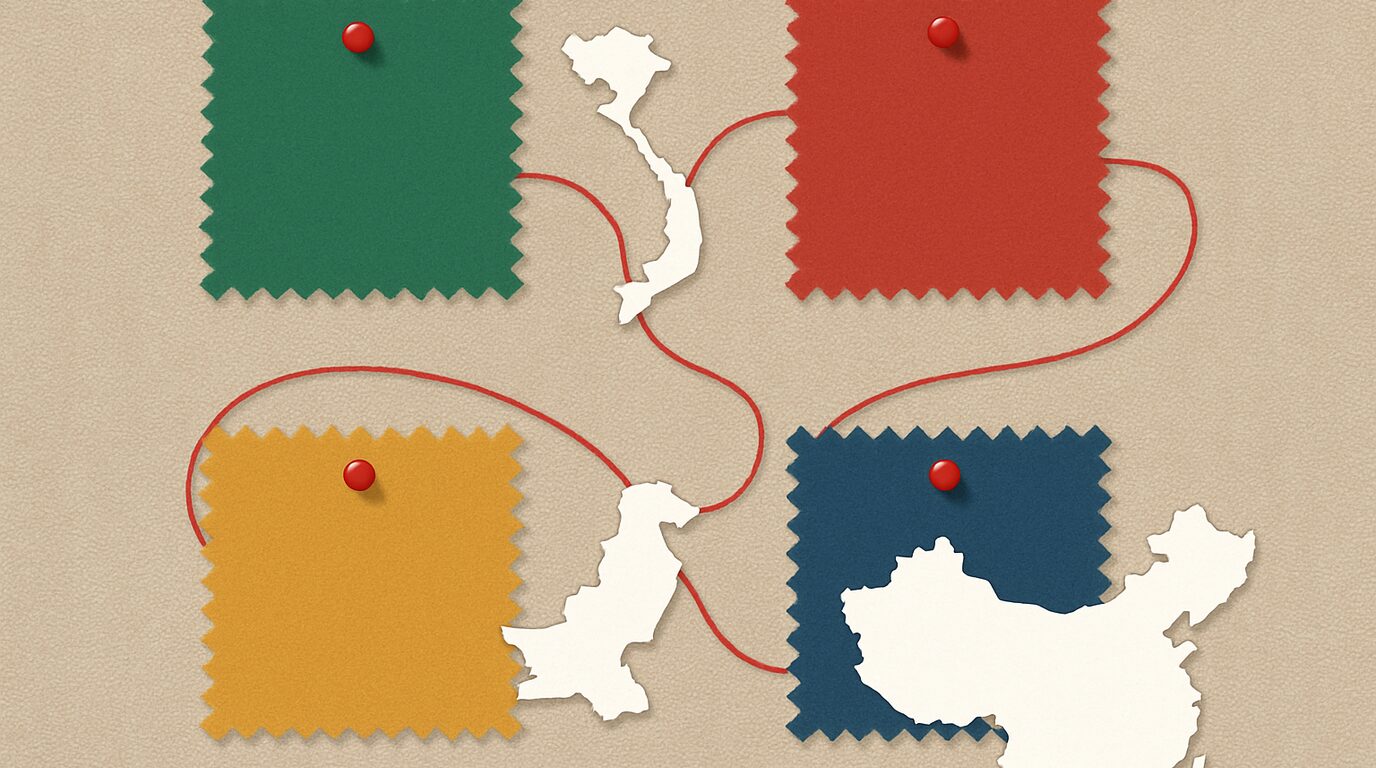













Landed cost is what a garment costs you when it is sitting in your warehouse in the EU, cleared and ready to sell: the factory price, plus freight and insurance, plus import duty, plus the fees to get it through customs. The factory quote is only the first line, and on a China order it can be barely 80% of the final number. Below we run the same 2,000-piece order through Vietnam, Turkey, Pakistan, and China so you can see where the money actually goes.
What goes into landed cost?
Four lines, in the order the money leaves your account. First the goods themselves, at whatever Incoterm you agreed. FOB means the factory delivers to the ship at their port and everything after that is yours; EXW means you also pay to get it from the factory gate to the port. Second, freight and insurance to your EU port or border. Third, import duty, which the EU calculates on the customs value, and for sea freight that is the CIF value: goods plus freight plus insurance. Duty on freight is the detail that surprises people. Fourth, the clearance and handling fees at the border, plus the last leg to your warehouse.
Import VAT sits on top of all of that, but a VAT-registered business claims it back, so we leave it out of the comparison. It is a cash-flow cost, and nothing more.
The worked example
Assume a 2,000-piece order of a mid-weight cotton hoodie, one style, three colours. To isolate the effect of duty and freight we use the same FOB price of 9.00 euro in all four countries; in reality the quotes will differ, and you should plug your own numbers into the same columns. Freight is quoted less-than-container-load by sea to Rotterdam from the three Asian origins and by road from Istanbul, at rates typical for 2026. Clearance and handling is a flat 350 euro.
| Line | Vietnam | Turkey | Pakistan | China |
|---|---|---|---|---|
| Goods, FOB (2,000 x 9.00) | 18,000 | 18,000 | 18,000 | 18,000 |
| Freight and insurance | 1,400 | 1,100 | 1,400 | 1,400 |
| Customs value (CIF) | 19,400 | 19,100 | 19,400 | 19,400 |
| Import duty | 0% (EVFTA) | 0% (Customs Union) | 0% (GSP+) | 12% = 2,328 |
| Clearance and handling | 350 | 350 | 350 | 350 |
| Landed total | 19,750 | 19,450 | 19,750 | 22,078 |
| Landed per piece | 9.88 | 9.73 | 9.88 | 11.04 |
| Lead time, production plus transit | 10 to 14 weeks | 4 to 7 weeks | 9 to 13 weeks | 9 to 13 weeks |
At an identical factory price, the Chinese hoodie lands 1.16 euro per piece dearer than the Vietnamese or Pakistani one, and 1.31 euro dearer than the Turkish one. On 2,000 pieces that is 2,328 euro of duty, which is roughly the cost of a return flight to visit the factory and a week of hotels. A Chinese factory has to quote just over 10% under its Vietnamese competitor just to land level.
Why the duty line is bigger than it looks
Two things make the 12% heavier in practice than on paper. It is charged on the CIF value, so you pay duty on your freight as well as your goods, and freight from China is not cheaper than freight from Vietnam. And it applies to every reorder for as long as you keep the supplier, while the duty-free status of the other three is written into a trade agreement and stays in place for every reorder. The one condition is paperwork. Vietnam needs a EUR.1 certificate or an approved-exporter origin declaration and fabric that meets the EVFTA origin rule; Pakistan needs a REX statement on origin; Turkey needs an A.TR movement certificate. If the factory cannot produce that document, you pay the full 12% and the duty-free column in the table is fiction. Ask for it before you order, not at the border.
Where the model is too simple
A single-style LCL shipment is the easy case. Once you ship a full container, freight per piece drops and the Asian origins pull further ahead on cost. Once you air-freight a late delivery, a Vietnamese order can cost more to land than a Turkish one that went by truck. And the FOB price will not be equal across the four; Turkey will usually quote higher on the goods and win back some of it on lead time and smaller minimums. Our comparison of where to make your product by category and order size covers those trade-offs, and the full duty table for both the EU and the UK is in our import duty cheat sheet.
Getting comparable quotes in the first place
The table only works if every quote is on the same Incoterm, the same quantity, and the same spec. A factory quoting EXW next to one quoting FOB looks 40 cents cheaper and is not. The way to force a fair comparison is to write one brief and send it to every factory unchanged; we explain how in how to write an apparel RFQ that gets real quotes.
Post one brief, in one format, and receive FOB quotes from verified factories in all four countries. Then run them through the table above. Post an RFQ on Lalaaji.
Your questions answered
What is landed cost in apparel?
Landed cost is the total cost of a garment delivered to your warehouse: the factory price, freight and insurance, import duty, and customs clearance and handling. Import VAT is usually excluded because a VAT-registered business reclaims it.
How is EU import duty on clothing calculated?
Duty is a percentage of the customs value. For sea freight that is the CIF value, meaning the goods plus freight plus insurance. Most finished apparel from China pays 12%, while apparel from Vietnam, Pakistan and Turkey enters at 0% when the correct origin document is supplied.
Is Chinese clothing cheaper than Vietnamese clothing after import duty?
At an equal factory price, no. The 12% EU duty means a Chinese garment lands roughly 12% dearer than the same garment from Vietnam or Pakistan, so a Chinese factory must quote just over 10% lower to land level.