App for sellers
Lalaaji.com is a platform built for your future, not your past.
Our mobile app gives you real-time access to thousands of leads in the palm of your hand.


Watch the demo 


 How it works
Learn how Lalaaji connects brands with verified manufacturers, from RFQ to delivery.
 Payment protection
Your transactions are protected with verified KYC, milestone-based tracking, and secure payment holds.
 Request a quote
Submit your requirements and let verified manufacturers come to you with competitive offers.
 Browse directory
Explore products and manufacturers across categories. Find the right production partner.
 Sell on Lalaaji.com
Join thousands of verified manufacturers who use Lalaaji.com to reach premium B2B buyers across the EMEA and beyond.
PricingTransparent pricing plans designed for factories of every size. Start free and scale as you grow.
 Authentication & verification
We protect your orders with verified buyer KYC, milestone-based tracking, and secure payment holds.
 Referral program
Know a manufacturer who could benefit from Lalaaji.com? Invite them to join and get cash rewards!
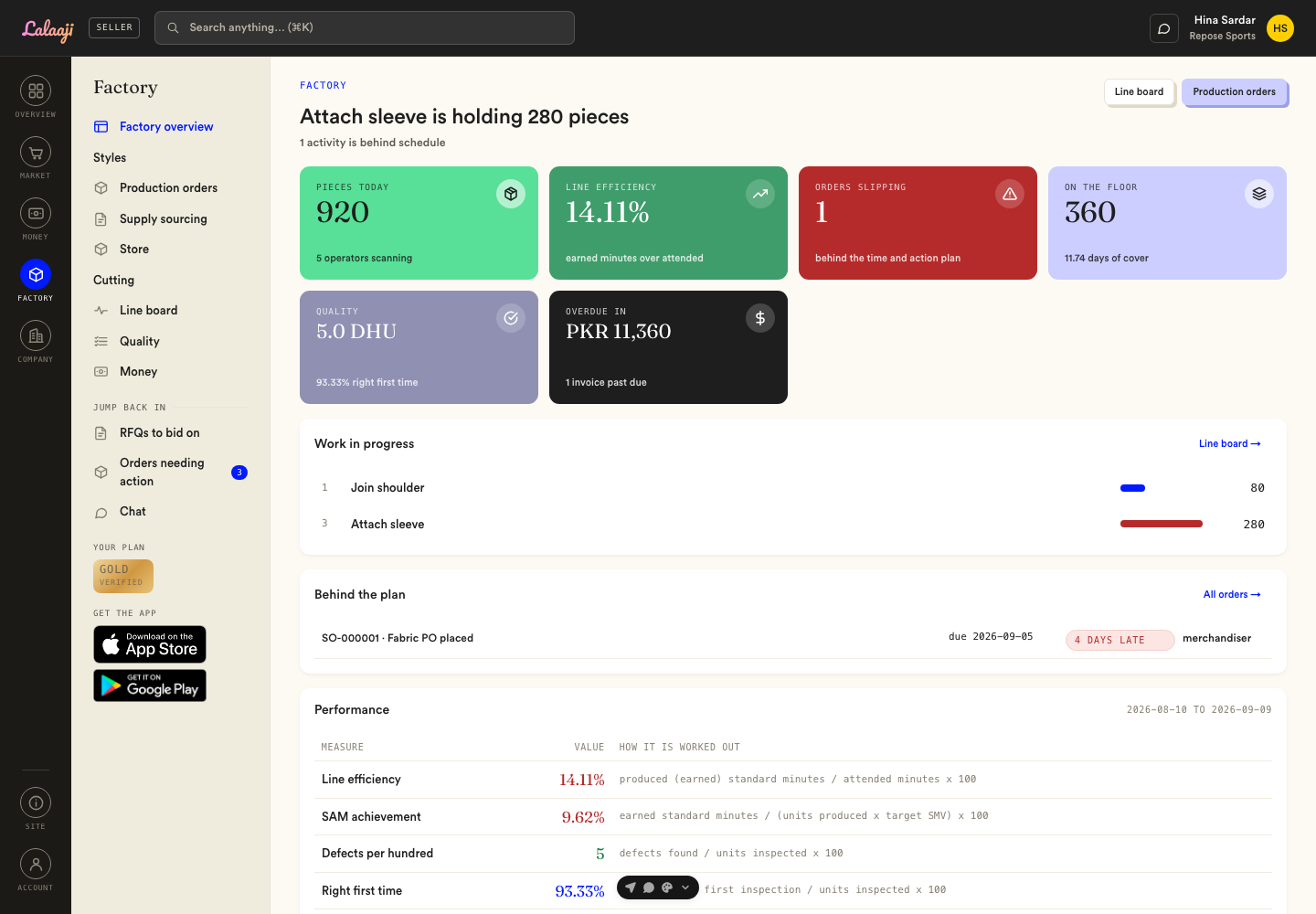 Factory ERP
Run the factory, not the spreadsheet: costing, cutting, bundle scanning, QC, payroll and export papers. Free for sellers.
Seller directoryProduct listings from verified apparel & textile manufacturers.
Lalaaji is the global B2B marketplace for built-to-order apparel and textiles, connecting brands with verified factories.
Our storyBorn to modernize the textile trade, Lalaaji.com empowers factories and brands to build smarter, faster, and together.
Investor relationsBacked by market traction and manufacturing depth, Lalaaji.com is building the operating system for global apparel production.
Become a partnerLalaaji.com connects you to a trusted network of vetted apparel and textile manufacturers.
How it works
Learn how Lalaaji connects brands with verified manufacturers.
Payment protection
Secure transactions with milestone-based payments and verified KYC.
Request a quote
Submit your requirements and let manufacturers come to you.
Browse directory
Explore products from verified manufacturers.
Sell on Lalaaji.com
Join thousands of verified manufacturers who use Lalaaji.com to reach premium B2B buyers.
Pricing
Transparent pricing plans designed for factories of every size.
Authentication & verification
Rigorous identity and business verification for all partners.
Referral program
Invite manufacturers to join and get cash rewards!
About Lalaaji.com
The global B2B marketplace for built-to-order apparel and textiles, connecting brands with verified factories.
 Our story
Born to modernize the textile trade.
Our story
Born to modernize the textile trade.
 Investor relations
Building the operating system for global apparel production.
Investor relations
Building the operating system for global apparel production.
 Become a partner
Join our network of vetted manufacturers.
Become a partner
Join our network of vetted manufacturers.
From the blog
 EU and UK Import Duty on Clothing by Country: The 2026 Cheat Sheet
29 August 2026 · 7 min read
EU and UK Import Duty on Clothing by Country: The 2026 Cheat Sheet
29 August 2026 · 7 min read
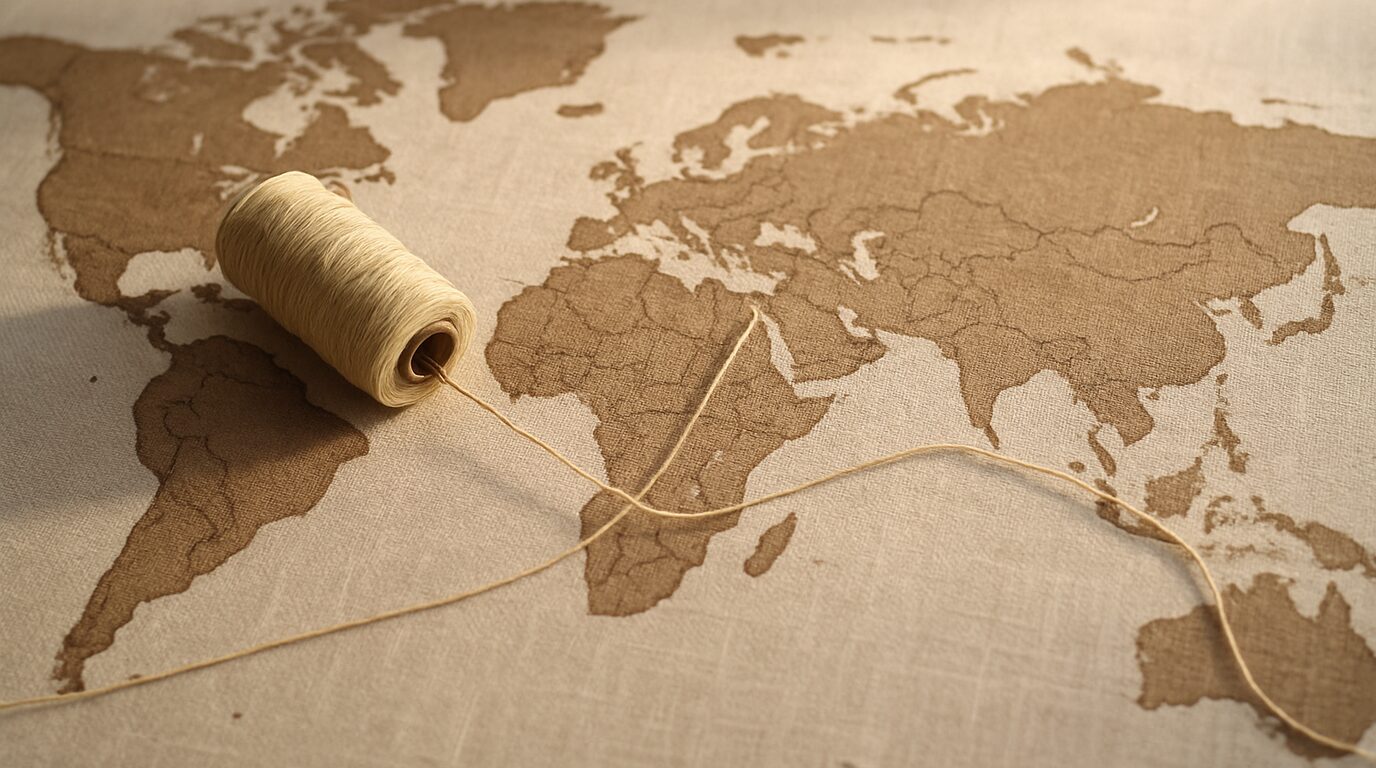 Dual Sourcing Apparel: Why Brands Split Orders Across Two Countries, and How Factories in Both Win
27 August 2026 · 8 min read
Dual Sourcing Apparel: Why Brands Split Orders Across Two Countries, and How Factories in Both Win
27 August 2026 · 8 min read
 Factory or Trading Company: How to Tell Which One You Are Talking To
25 August 2026 · 7 min read
View all posts ›
Factory or Trading Company: How to Tell Which One You Are Talking To
25 August 2026 · 7 min read
View all posts ›
Seller services
Factory ERP is a full manufacturing system for apparel units under 200 machines. Styles and costing, BOM and material planning, cutting and bundle tracking, quality, payroll and export papers. Built for how these factories actually work: cheap Android phones on the floor, the operator's own language on screen, and nothing that stops working when the wifi does.
Free for Lalaaji sellers. No per-user charge, so every operator can be on it.
Open my factory See the shop-floor appSwitched on per seller by the Lalaaji team. Sign in and open Factory, or ask us to have it enabled. Not a seller yet? Get started.
The problem
Which works, until a shade gets mixed into a lay, a trim order is short by 3,000 buttons, or nobody can say where 40,000 pieces actually are.
Output is counted once, at the end. By the time a bottleneck shows up in the numbers, the day is already lost.
Without lot and shade tracking, fabric is issued on trust and utilisation is a guess. Two shades in one garment is a rejected carton.
A quote built in a spreadsheet is out of date the day it is sent, and nobody re-derives it because it means retyping everything.
Counting chits by hand for 200 workers takes days, and the operator who worked hardest cannot prove it.
What it covers
One style with 5 colours and 7 sizes gives you 35 SKUs automatically. Size runs are reusable, so the next style takes a minute.
Change a fabric price or an SMV and the quoted cost moves with it. A quote converts to a sales order without re-entering a single line.
Fabric consumption is held per size, so a size-heavy order does not quietly under-order cloth. MRP nets off what is already in store and drafts the purchase orders.
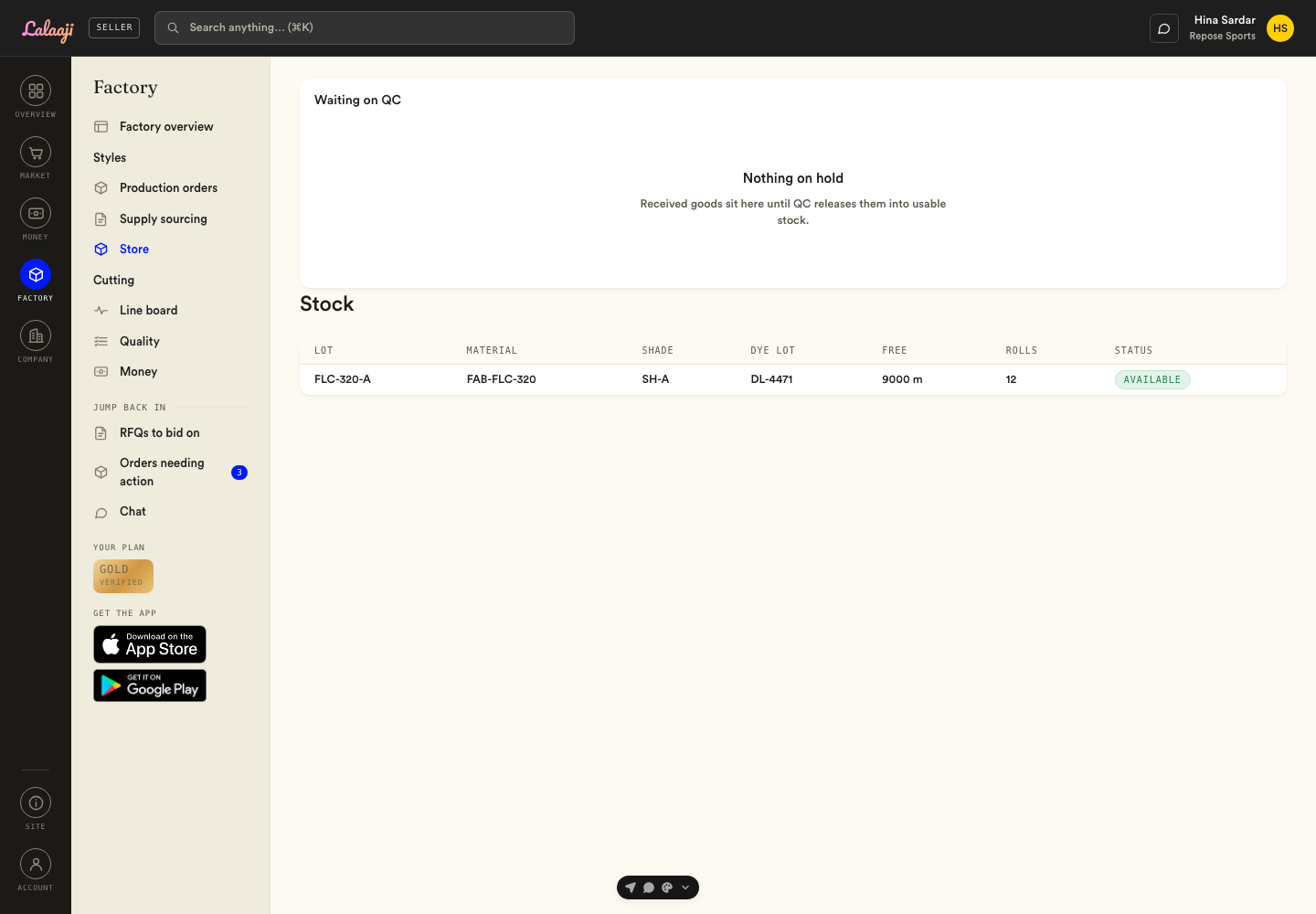
Goods land on QC hold, not straight into stock. Rolls carry width, GSM, weight and yardage, and a cut order allocates by shade so a garment is never two shades.
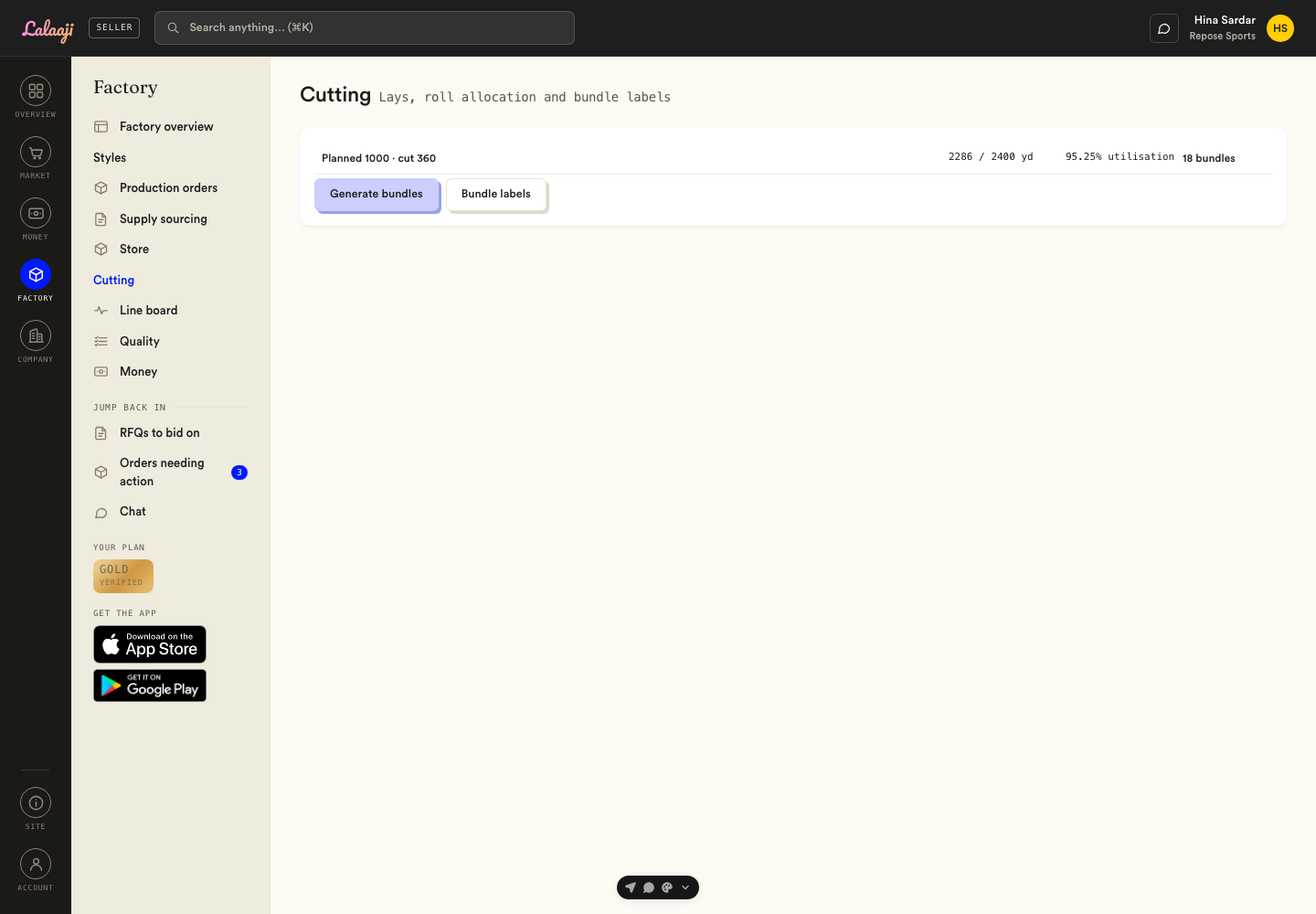
Every bundle gets a QR carrying style, colour, size, quantity, lay and lot. Fabric utilisation is a number, not an argument.
Bundles are scanned through each operation on a cheap Android phone. WIP, efficiency and the bottleneck are visible while the day is still fixable.
DHU and RFT by line and by operation, traced back to the operator. Final inspection uses the ISO 2859-1 Level II plan your buyer already audits against.
Pack plans, carton contents by size ratio, packing list and carton labels that add back up to the order quantity.
A critical path per order, counted in working days around your weekly off and every holiday on your calendar, with an alert the moment something slips.
Commercial invoice, packing list, certificate of origin and the LC set, plus the exchange-control form your bank needs and the customs declaration your single window expects, named the way your country names them.
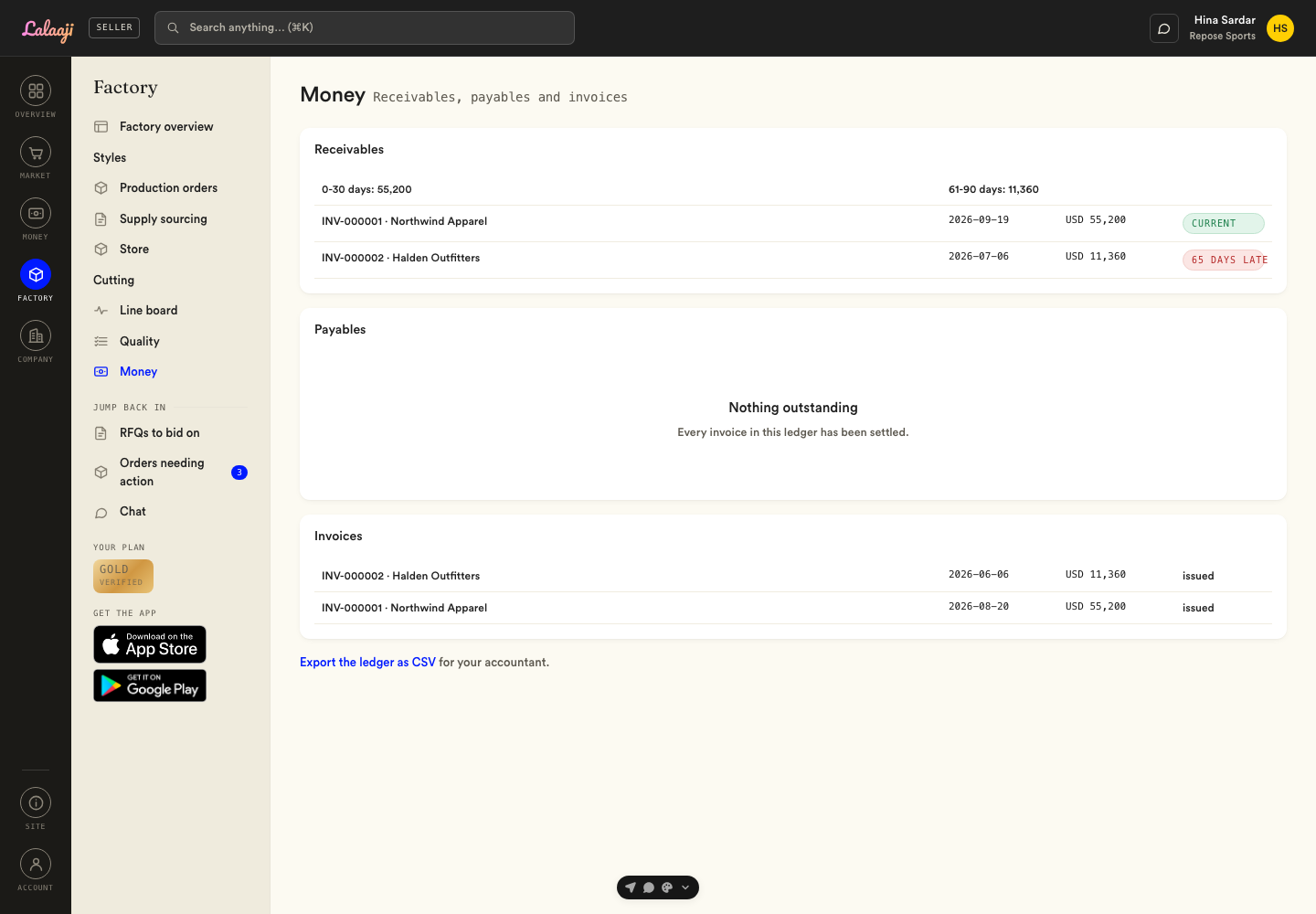
Invoice from the order, age your receivables, and hand your accountant a ledger CSV instead of a shoebox.
Piece-rate pay comes straight from the scans, with the skill multiplier applied and the minimum wage guaranteed. The wage register exports.
Only on Lalaaji
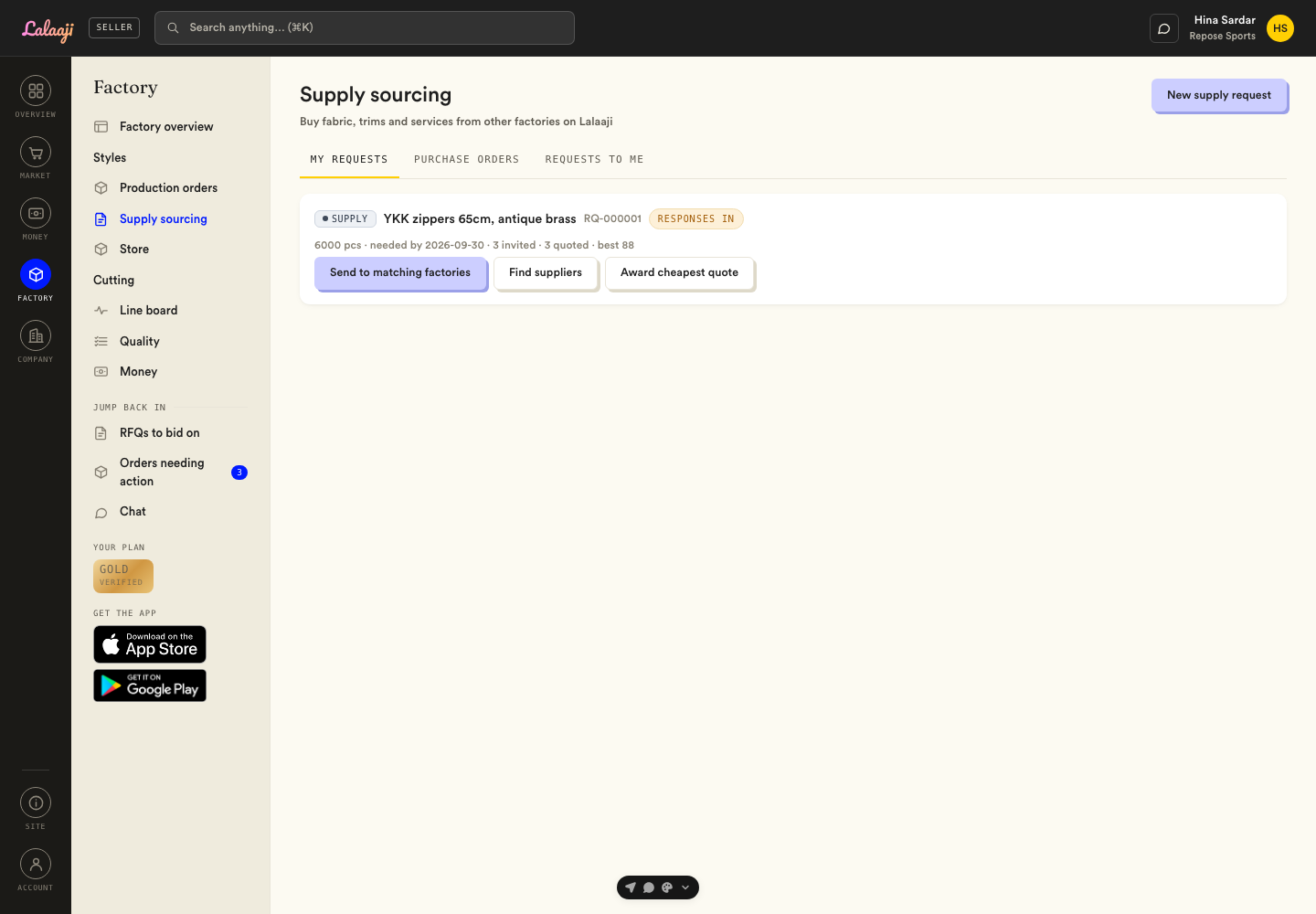
Your BOM sits inside a marketplace with 20,000 factories on it. So sourcing stops being a separate job.
Search the catalog for the button, zipper, label, thread or fabric you just specified, and link the listing to the line. The seller comes with it, into MRP and onto the purchase order.
One request reaches matching suppliers, using the capability data Lalaaji already holds on every listed factory. Quotes come back in the same screen.
Place the purchase order on a Lalaaji seller and a supplier conversation opens alongside it, marked clearly as supply so it is never confused with a buyer chat.
Pick a subcontractor by capability, issue the material, and the stock leaves your store so on-hand never counts goods sitting at someone else's unit.
Built for the floor
The shop-floor screens translate, and a right-to-left script flips the whole interface, numbers included, so operators can work without English. Urdu ships today; adding a language is a list of words, not a rebuild.
Scans are written to the phone first and pushed when there is signal. A retry never double-counts a bundle.
Planning counts working days around your weekly off, your public and religious holidays and whatever buffer you set for power cuts. Set up a factory and it starts with its own country's calendar.
Cost in the money you pay wages in, quote in dollars or euros, and keep the books straight with a dated exchange rate.
The national ID, pension and social security fields your labour inspector asks for, under the names they use locally, overtime at your country's statutory multiplier, and a minimum-wage floor that cannot be undercut by a slow week.
Everyone from the owner to the line supervisor works off the same numbers, so nobody is reconciling two versions of the cut quantity.
A day in the system
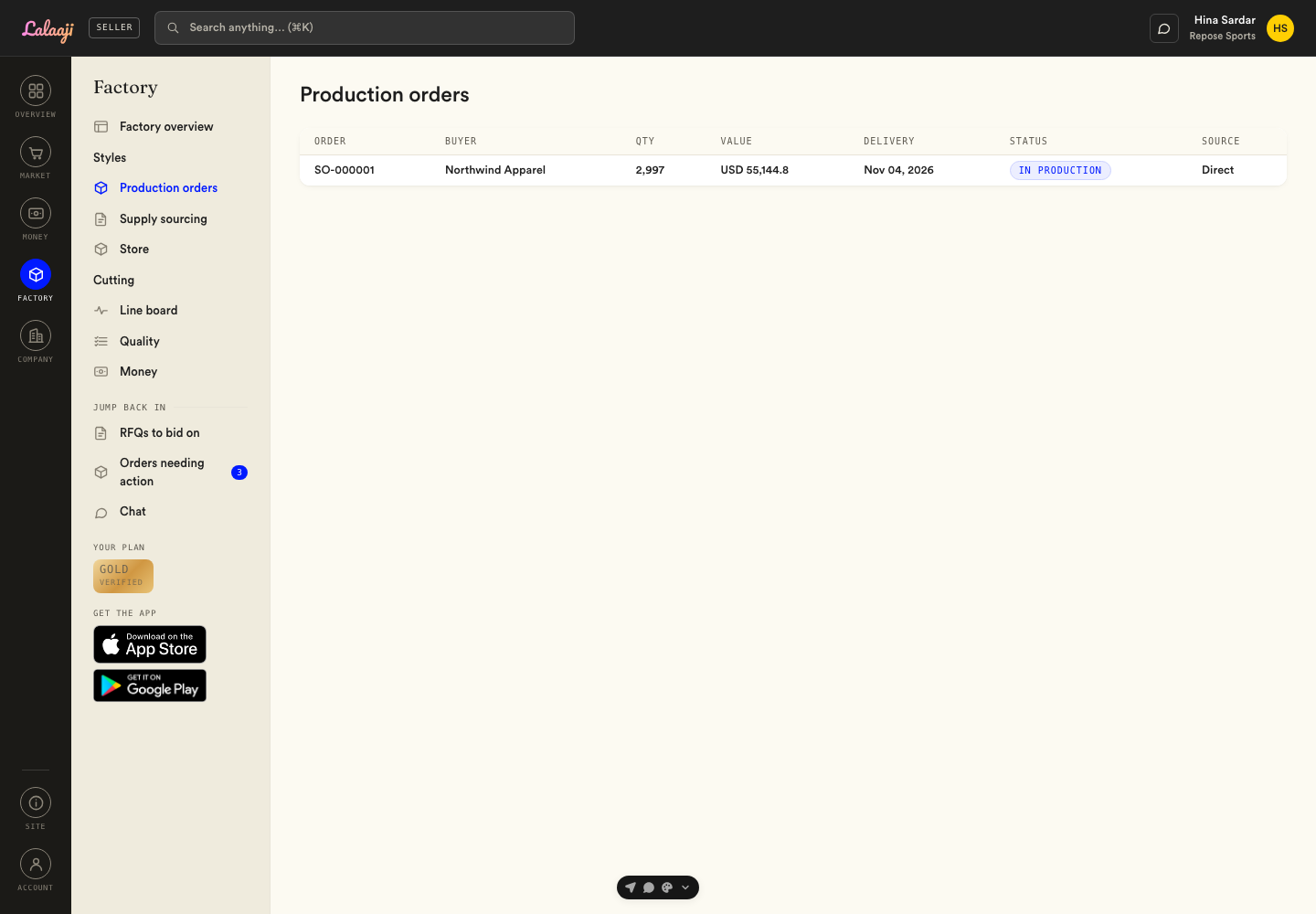
The Lalaaji advantage
Factories in this region typically run at 40 to 55 percent efficiency with 5 to 8 DHU. You cannot move either number without measuring it at the bundle. That is what this does, on the phone already in your supervisor's pocket.
Open my factoryHear directly from the people who source on the platform.
🇺🇸 DTC apparel brands in the United States·🇸🇦 Retail groups and distributors in Saudi Arabia·🇳🇱 European wholesalers in the Netherlands and Germany
🇦🇪 E-commerce platforms and hypermarkets in the UAE·🇿🇦 Fashion chains in South Africa·🇬🇧 Independent fashion labels in the UK

Learn the exact steps to prepare your factory, prevent rejections, and impress global buyers, every time.

Watch the video
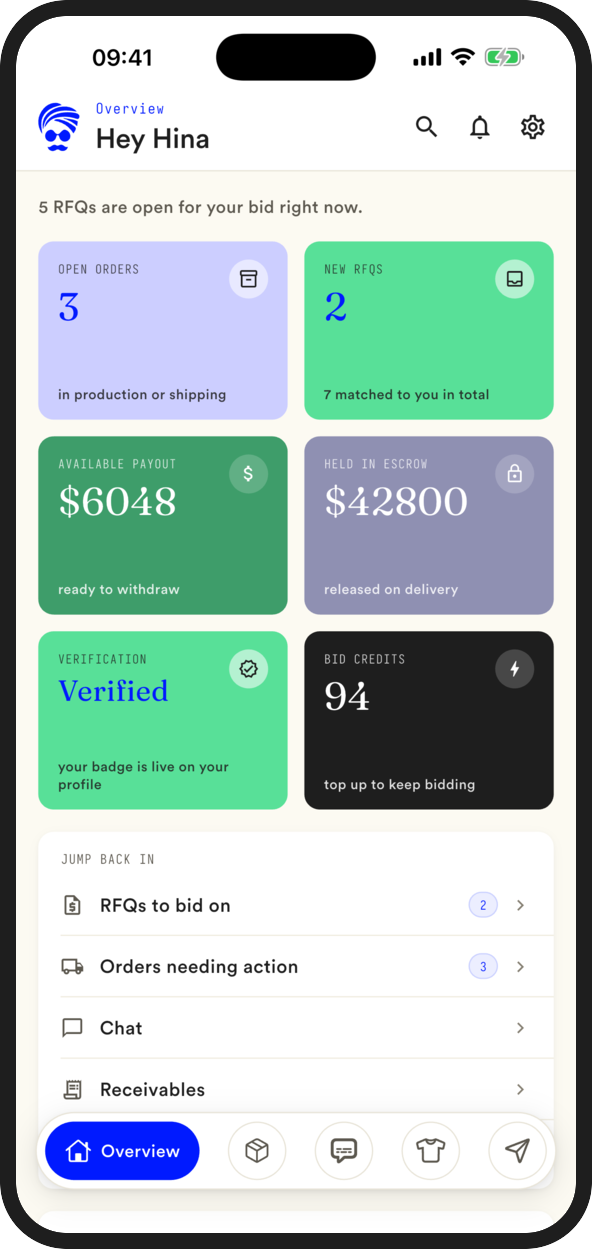

Lalaaji.com is a platform built for your future, not your past.
Our mobile app gives you real-time access to thousands of leads in the palm of your hand.