











When 2,000 hoodies sit packed in cartons at the factory, nobody is going to open and check all 2,000 of them. An inspector pulls a random sample, checks each piece against your approved sample and spec, counts the defects, and compares the count with a limit you agreed in advance. The method is called AQL inspection, and in apparel it decides whether an order is accepted or rejected. In most orders it is also the last step before the balance leaves your account. Get it wrong and you pay full price for the defects.
This guide covers how it works for clothing, which numbers to use, and how to write it into your order.
What AQL means
AQL stands for Acceptance Quality Limit (older documents say Acceptable Quality Level). AQL is the worst defect rate you are willing to accept as a process average, expressed as a percentage. "AQL 2.5 for major defects" means you accept that, across your orders, up to about 2.5% of pieces could have a major defect.
The sampling tables come from the ISO 2859-1 standard, which is equivalent to the older ANSI/ASQ Z1.4 and MIL-STD-105E tables, and every inspection company works from the same tables, so you don't need to buy the standard to use it. What you do need is to agree three things with the factory before production:
- The inspection level (almost always General Inspection Level II)
- The AQL for each defect class (critical, major, minor)
- What counts as each class of defect for your product
Defect classes for clothing
A critical defect is one that could hurt the user or break the law: a broken needle or metal fragment in the garment, a drawcord on a children's hood, missing or wrong safety warnings, mould. The usual AQL for critical defects is 0, which means a single critical defect fails the lot.
A major defect makes the garment unsellable or likely to come back as a return: a hole, an open seam, a measurement out of tolerance, a wrong colour or shade, a misplaced or wrong print, a stain that won't wash out, a broken zip, a wrong size label.
Minor defects are visible but won't stop most people buying: an untrimmed thread, a slightly uneven topstitch, a small mark that comes off, a crooked hangtag.
Write the list down. "Measurement out of tolerance" only means something if your tech pack has tolerances, and a 2 cm thread end will be a minor defect to you and no defect at all to the factory unless you both agreed on it first. An AQL with no written defect list is worth very little.
The usual standard for apparel
Most fashion and sportswear brands use:
| Defect class | AQL |
|---|---|
| Critical | 0 |
| Major | 2.5 |
| Minor | 4.0 |
Premium brands sometimes use 1.5 for majors, and promotional and budget goods sometimes use 4.0. Whatever you choose, put it in the purchase order.
Sample sizes and limits
At General Inspection Level II, the number of pieces checked depends on the order quantity. The table shows the sample size and the maximum number of defects allowed (accept) before the lot fails (reject = accept + 1).
| Order quantity | Sample size | Major, AQL 2.5: accept / reject | Minor, AQL 4.0: accept / reject |
|---|---|---|---|
| 91 to 150 | 20 | 1 / 2 | 2 / 3 |
| 151 to 280 | 32 | 2 / 3 | 3 / 4 |
| 281 to 500 | 50 | 3 / 4 | 5 / 6 |
| 501 to 1,200 | 80 | 5 / 6 | 7 / 8 |
| 1,201 to 3,200 | 125 | 7 / 8 | 10 / 11 |
| 3,201 to 10,000 | 200 | 10 / 11 | 14 / 15 |
| 10,001 to 35,000 | 315 | 14 / 15 | 21 / 22 |
A worked example: you ordered 2,000 hoodies. The inspector checks 125 pieces chosen at random from across the cartons and finds 6 major defects and 9 minor defects. Majors are within the limit of 7 and minors within the limit of 10, so the lot passes. Had the inspector found 8 majors, the lot would fail, even with zero minors.
The accept numbers apply to each defect class separately, so a lot can pass on majors and still fail on minors.
What an inspector checks
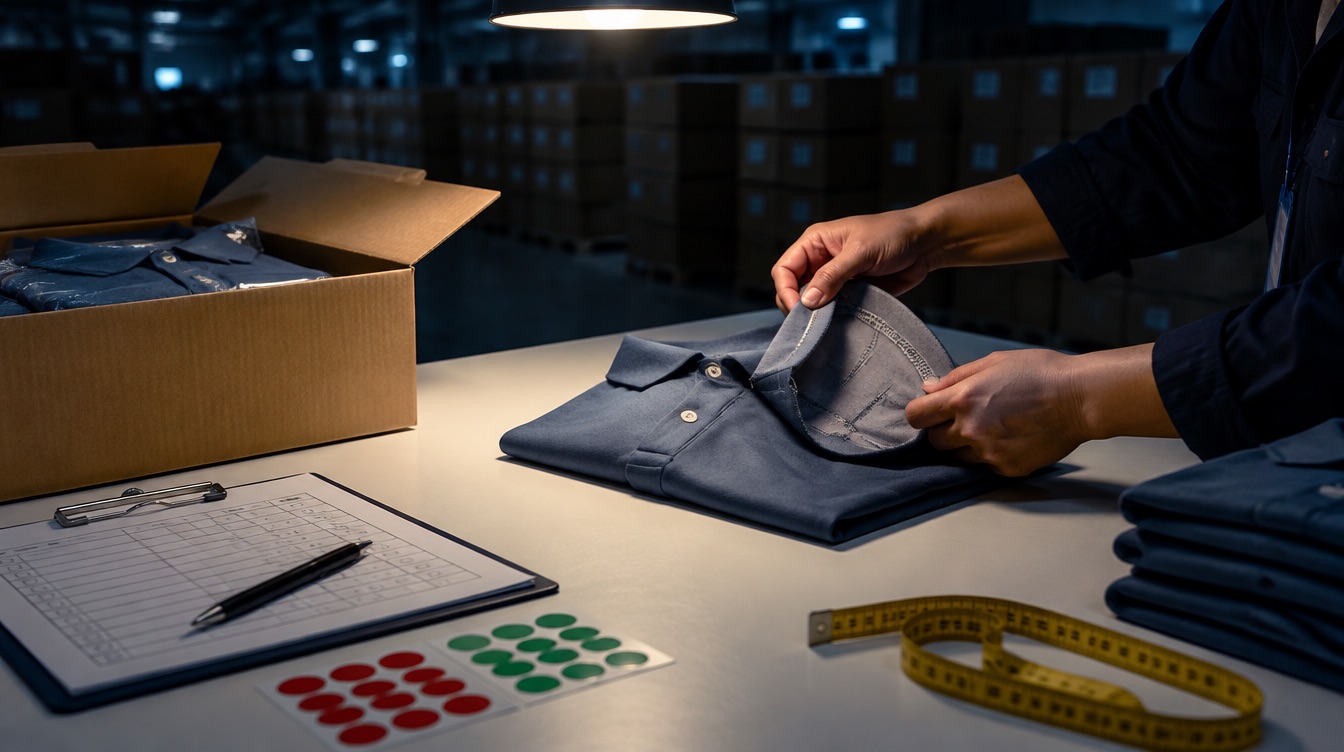
A typical final random inspection for apparel covers:
- Quantity: cartons and pieces against the packing list, and the assortment of sizes and colours
- Packing and marking: carton marks, polybags, folding, barcodes, labels
- Workmanship: every sampled piece checked for defects against the approved PP sample
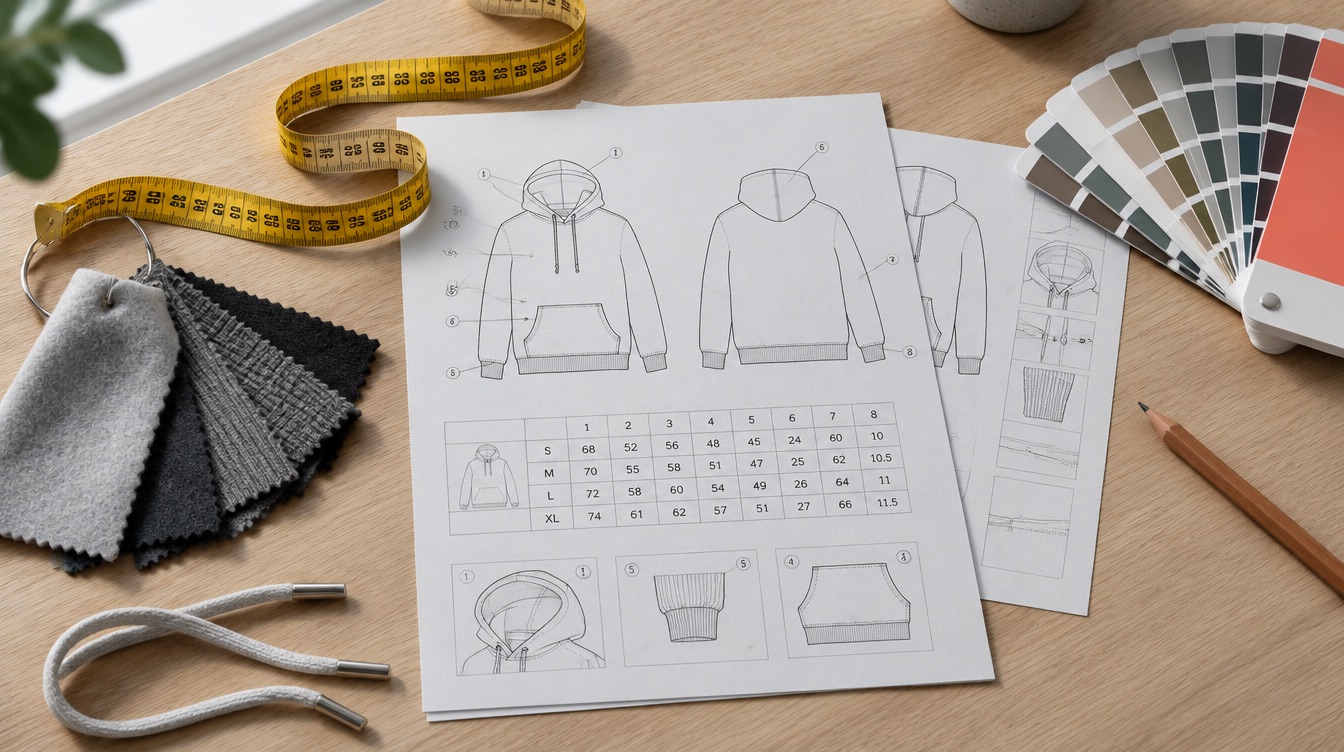
- Measurements: a smaller sub-sample measured against the spec, usually a few pieces per size
- On-site tests: colour comparison under a light box, barcode scan, zip and snap pull tests, carton drop test, and a needle-detection check where required
The inspector works from the signed pre-production sample, so you need one before the inspector arrives. See the apparel sampling process for how that sample is approved.
When to inspect
The final random inspection happens when at least 80% of the order is finished and packed, so the inspector can draw a random sample from real cartons. For new factories or large orders, add a during-production inspection at around 20 to 30% complete. A check at that stage catches systematic problems (a wrong measurement on every piece, a shade off on one fabric roll) while the factory can still fix them on the remaining pieces.
What happens if the order fails
The big question is: what do you do when the inspector's count goes over the limit? A failed inspection doesn't automatically mean you reject the goods. The usual options are:
- The factory sorts 100% of the order, repairs or replaces defective pieces, and books a re-inspection, normally at its own cost.
- You accept the goods at a discount, if the defects are cosmetic and you can sell them.
- You reject the lot, if the defects are serious and can't be fixed, under the terms in your contract.
Sorting and re-inspection is the usual outcome. Write who pays for re-inspection into the purchase order before production starts, because after a failed lot every factory remembers the deal differently.
Linking inspection to payment
Inspection only protects you if the money hasn't all gone yet. Just as you would get a survey on a house before you hand over the full price, you check the goods before you hand over the balance, because a survey that lands after the money has gone gives you a report and no leverage. A common structure in apparel is 30% deposit after PP sample approval and 70% balance after a passed final inspection. If a factory insists on full payment before inspection, ask why.
When you pay through Lalaaji, we hold the funds and release them against milestones such as sample approval, production and delivery, so the balance doesn't leave until those steps are met. See how payment protection works.
Who carries out the inspection
You can send your own QC person, hire a third-party inspection company, or rely on the factory's in-house QC report. The in-house report is written by the party being judged. Third-party inspection companies operate in all the main producing countries and charge per person-day, and for a first order with a new factory an independent inspection is worth the cost. Once you trust a factory's results, you can switch to inspecting every second or third order.
Putting it in your order
Add these lines to your purchase order or RFQ:
- Inspection standard: ISO 2859-1, single sampling, normal, General Inspection Level II
- AQL: critical 0, major 2.5, minor 4.0
- Final random inspection at 80% packed; during-production inspection at 20 to 30% (first orders)
- Reference: signed PP sample and tech pack version X
- Failed inspection: factory sorts and repairs at its own cost; re-inspection paid by factory
- Balance payment due after passed final inspection
Our RFQ checklist has a quality line for exactly this.
Your questions answered
What does AQL 2.5 mean for garments?
It means the buyer accepts a defect rate of up to about 2.5% for major defects as a process average. In practice, for an order of 1,201 to 3,200 pieces, the inspector checks 125 pieces and the lot passes if 7 or fewer have major defects.
What AQL do clothing brands use?
The common standard is 0 for critical defects, 2.5 for major defects and 4.0 for minor defects, at General Inspection Level II.
How many garments are checked in an AQL inspection?
It depends on the order size. At General Inspection Level II, 80 pieces are checked for orders of 501 to 1,200, 125 for 1,201 to 3,200, and 200 for 3,201 to 10,000.
When should a pre-shipment inspection happen?
When at least 80% of the order is finished and packed, so the sample can be drawn at random from packed cartons.