











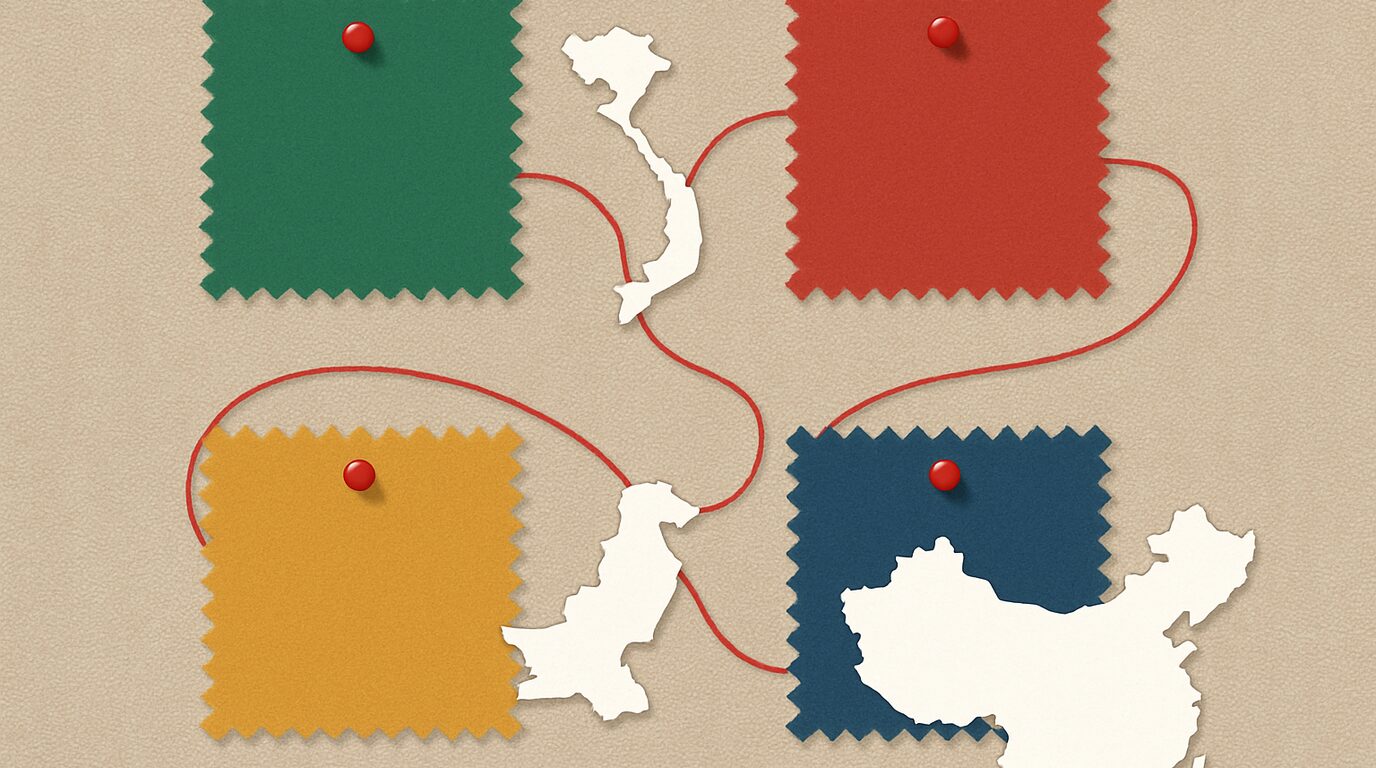
There is no best country to manufacture clothing. There is a best country for your product, your order size, and your calendar, and it is usually one of four: Vietnam, Turkey, Pakistan, or China. A European brand that wants 300 technical jackets in six weeks and a brand that wants 20,000 basic tees at the lowest possible cost should not land in the same factory, or the same country. This guide sorts the four by what they actually do well, so you can shortlist in an afternoon.
The four countries side by side
Every one of these countries makes every category of garment somewhere. The table is about where each one is strongest, what order size the typical export factory is built for, and what the goods cost you at the EU border. Lead time is production plus sea or road transit to a Dutch or German warehouse on a repeat order; a first development run takes longer.
| Country | Strongest categories | Sweet-spot order size | Lead time to EU | EU import duty on apparel |
|---|---|---|---|---|
| Vietnam | Outerwear, activewear, technical knits, footwear-adjacent softgoods | 2,000 to 20,000 pieces per style | 10 to 14 weeks | 0% under EVFTA (with origin paperwork) |
| Turkey | Denim, fashion knits, womenswear, small-run fast fashion | 300 to 5,000 pieces per style | 4 to 7 weeks | 0% under the EU Customs Union |
| Pakistan | Denim, towels and home textiles, sportswear and teamwear, basics in cotton | 1,000 to 15,000 pieces per style | 9 to 13 weeks | 0% under GSP+ |
| China | Everything, with the deepest fabric and trim base; complex and technical pieces | 500 to 50,000 pieces per style | 9 to 13 weeks | 12% MFN |
Read the last column twice. Three of the four ship into the EU duty-free, and the one that does not is the one most brands default to. On a garment with a customs value of 10 euro, that 12% is 1.20 euro before you have paid a cent of freight. It does not decide the choice on its own, but it is the single biggest line item most founders forget when they compare quotes.
Which country fits your product?
Start with the category, because that is what the factories are tooled for. Vietnam has spent fifteen years building the outerwear and activewear base that the big sports brands trained, which is why a seam-sealed shell or a bonded fleece comes out of Vietnam cleaner than almost anywhere. Turkey owns denim and womenswear in the European wardrobe; the mills in Istanbul and the laundries around Izmir are a short truck ride from your warehouse. Pakistan is cotton country: denim, towels, cotton basics, and a sportswear and teamwear cluster in Sialkot that has been stitching for European clubs for decades. China is the deepest bench in the world, and if your piece needs an unusual fabric, a specialist trim, or a construction nobody else has attempted, China is where it gets solved first.
The mistake we see most is a brand that picks a country on price and then fights the factory for a category it does not really make. A Turkish factory can sew a puffer jacket. It will not do it as well or as cheaply as a Vietnamese one that sews nothing else.
Which country fits your order size?
Order size matters as much as category, and this is where small brands go wrong. A factory running 2,000 workers on a 20,000-piece programme will take your 500-piece order to fill a gap in the line, and it will drop your order the moment a real one appears. Turkey and the smaller Chinese workshops in Guangdong are built for the 300 to 3,000 range. Vietnam and Pakistan start to make sense from about 1,000 pieces per style, and they get materially cheaper at 5,000 and above. If you are placing under 500 pieces, Turkey is the honest answer for most products, and the extra cost per piece buys you a factory that actually wants the order.
Which country fits your calendar?
Here Turkey wins outright. A truck from Istanbul reaches Rotterdam in four to six days. A container from Ho Chi Minh City, Karachi, or Shanghai spends four to six weeks at sea, depending on whether it goes through Suez or round the Cape, and that is before a port strike. If you replenish in season, or if your customers have been trained by fast fashion to expect new drops monthly, the Asian lead time is a structural problem no discount fixes. If you plan two seasons ahead and ship once a quarter, the sea leg is a spreadsheet cell and Asia wins on cost.
How the choice changes for a European brand in 2026
Ten years ago the answer to this question was China, with Turkey as the nearshore option for the impatient. US tariffs have pushed American brands into Vietnam and pulled Chinese capacity toward Europe at the same time, the Bangladesh duty-free window closes in 2029, and the EU's own rules on sustainability reporting now reach into your supply chain. The practical result is that the four countries in the table have separated into clear jobs. Nobody is the cheapest at everything anymore. That suits a brand founder, because a country with a clear job is easier to pick than a country that claims to do it all.
A growing number of brands now split a programme across two of these countries rather than betting everything on one; we cover the mechanics in dual sourcing apparel. For the full cost picture beyond the duty column, see landed cost for apparel into the EU.
Country guides for each shortlist
Once you have narrowed to one or two countries, the next question is how to find a real factory there and check it. We wrote a buyer's guide for each: clothing manufacturers in Vietnam, clothing manufacturers in Turkey, clothing manufacturers in Pakistan, and sourcing clothing from China in 2026.
The fastest way to test a shortlist is to put the same brief in front of verified factories in all four countries and compare the quotes that come back. Post an RFQ on Lalaaji and let the factories tell you which country wants your order.
Your questions answered
Which country is cheapest for manufacturing clothing for a European brand?
At the factory gate, Pakistan and Vietnam usually quote lowest on cotton basics and activewear, and China on complex pieces. After the 12% EU import duty on Chinese apparel, Vietnam, Pakistan and Turkey often land cheaper than China for the same garment.
Which country has the shortest lead time to Europe?
Turkey. A truck from Istanbul reaches Rotterdam in four to six days, so a repeat order can land in four to seven weeks. Vietnam, Pakistan and China need nine to fourteen weeks including four to six weeks at sea.
Which country is best for small clothing orders under 500 pieces?
Turkey for most products, and small workshops in Guangdong for complex pieces. Vietnamese and Pakistani export factories are built for 1,000 pieces per style and up.