












A Vietnamese garment factory finds European buyers without a sourcing agent by doing three things the agent used to do for it: being visible where European brands search, answering enquiries in the form those brands expect, and carrying its own compliance paperwork so nobody has to vouch for it. None of that is complicated. It is mostly work that factories in Ho Chi Minh City and Hanoi have outsourced for so long that they assume it cannot be done in-house. It can, and the margin you keep is the agent's commission.
Agents and buying offices have been the default route into Europe for a generation of Vietnamese exporters, and they earned their fee when a factory had no other way to be seen. That has changed. A brand founder in Rotterdam or Berlin now shortlists suppliers from a laptop, and the factory that appears in that shortlist with clean information gets the enquiry. The one that only exists in an agent's catalogue gets whatever the agent decides to pass on, at whatever price the agent decides to quote.
What the agent was actually doing for you
Be precise about the job before you replace it. An agent did four things: found the buyer, translated the brief into a tech pack you could cost, held the buyer's hand through sampling and QC, and took the credit risk or at least the awkward conversation about payment. For that they took somewhere between 5% and 10% of FOB, sometimes more on small brands. Some of that work still needs doing. The question is who does it and whether the fee matches the effort.
Be where European brands actually look
The first move is presence. European buyers searching for Vietnamese capacity look in three places: B2B sourcing platforms, trade fairs (Texworld and Première Vision in Paris, Munich Fabric Start, ISPO for sportswear), and the referrals of other brands. The fairs cost money and time. The referrals come later. The platforms are where a factory can be found tomorrow, and the ones built with the factory as the customer are the ones worth your effort. We compared them in B2B apparel sourcing platforms: where to list as a manufacturer.
Whichever you choose, the profile has to do the agent's job of making you look as good online as you are on the floor. That means real photos of your lines, your sample room, and your finished goods, not stock images. Your machine list. Your monthly capacity in pieces. Your certificates with dates. And the products you actually make, described in the words a European merchandiser uses: "circular knit polyester training tee, 160 gsm, flatlock seams". A profile that just says "sportswear" tells them nothing.
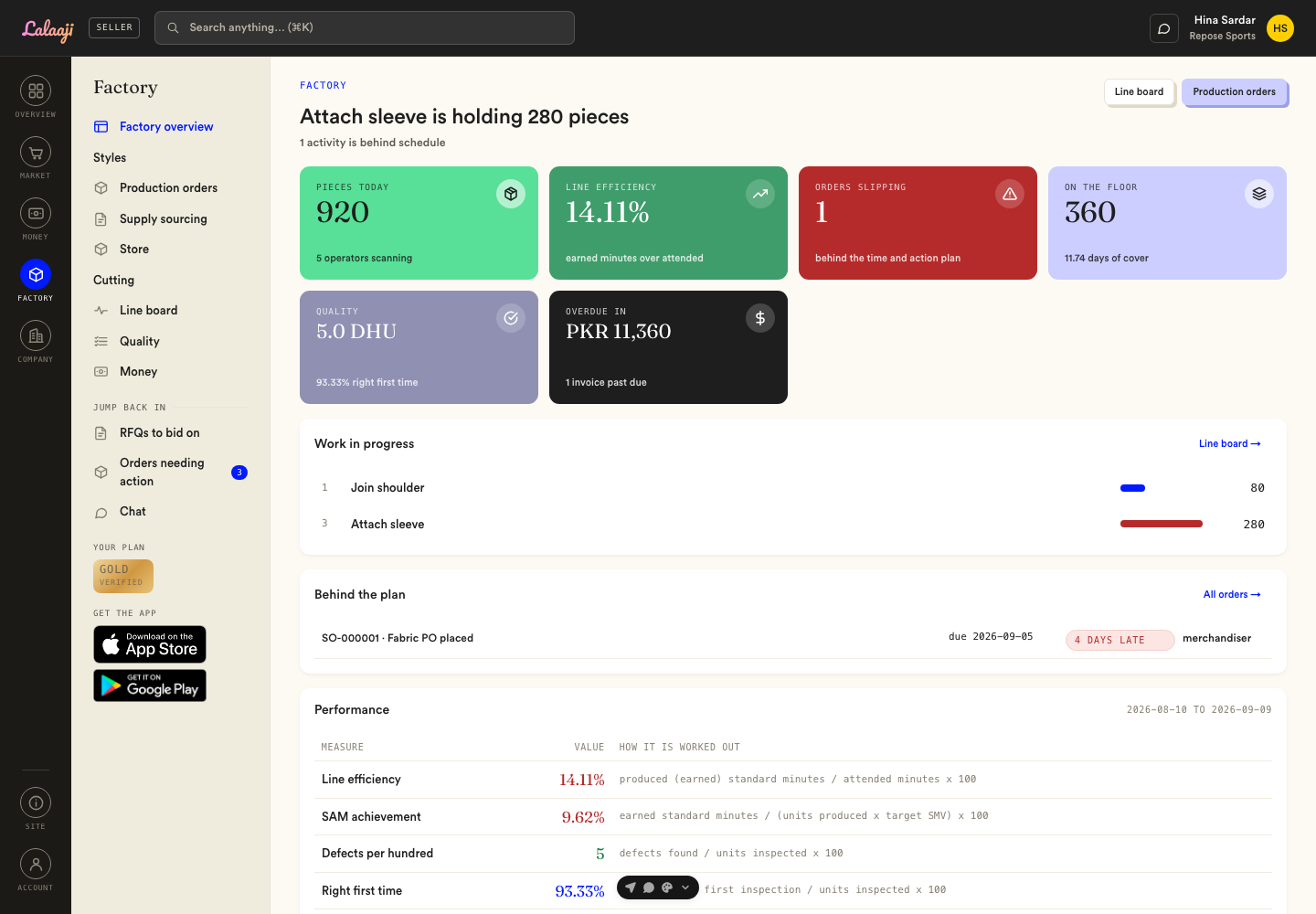
On Lalaaji, European brands post requirements and verified factories quote directly. There is no agent in between, and the buyer sees your certificates, your capacity, and your photos before they message you. See how RFQs reach sellers.
Answer the enquiry the way a European buyer expects
This is where most direct attempts die. The brand sends a tech pack and a target quantity. The factory replies "yes we can do, please send more details" and the thread goes quiet. A European buyer expects a costed reply within 48 hours that states the FOB price, the MOQ, the fabric source, the lead time from approved sample, the sample cost, and the payment terms. If the tech pack is incomplete, say exactly which three things are missing. If the quantity is below your MOQ, say what the MOQ is and what the price would be at it. Precision is the whole game.
The buyer is also comparing you against a Chinese quote, almost always. The argument that wins that comparison for Europe is duty, and it is worth stating on the quote itself. Vietnam ships most apparel lines into the EU at zero duty under the EVFTA; China pays 12%. How to phrase that, and how to prove it, is in Vietnam vs China: what to tell a European buyer who is comparing you.
Carry your own compliance
An agent's other quiet service was vouching for you. Without one, your paperwork has to vouch for itself. European buyers, especially German ones since the supply chain due diligence law, want a social audit (BSCI or SEDEX) under two years old, Oeko-Tex on the product, and a clear answer on the EVFTA origin of the fabric. Have the documents scanned and ready before the first enquiry. The full list a buyer works through is in how buyers vet apparel manufacturers.
How to handle payment and English
Two objections come up in every conversation about going direct. The first is payment risk: who chases a European brand that pays late? Use a platform with payment protection so the buyer's money is committed before you cut fabric, and quote standard terms (30% deposit, balance against shipping documents), which every European buyer already recognises. The second is English. You do not need a fluent English speaker on staff. You need one person, often a younger family member or a merchandiser, who can read a tech pack, write a precise costed reply, and reply within a day. That person is worth more than the agent was.
Keep the agent where they still earn it
Going direct is a portfolio decision and you can make it account by account. For a large retailer with a complex vendor programme, an agent or buying office may still be the only door, and the fee is justified. For the hundreds of mid-sized European brands placing 500 to 5,000 piece orders, which is where the margin is, the agent adds cost and delay. Take those buyers direct, keep the agent for the accounts that need one, and watch what the mix does to your margin over a year. Which of those brands to target first, if you make performance knits, is in how Vietnamese activewear and knitwear factories reach EU sportswear brands.
The agent's fee was the price of being invisible. Once you are visible, it is just a fee.
Ready to take European buyers direct, with payment protection and your paperwork on show? List your factory on Lalaaji.
Your questions answered
How much does a sourcing agent charge a Vietnamese garment factory?
Typically 5% to 10% of the FOB value, sometimes more on small brand orders. That is the margin a factory keeps when it works with European buyers directly.
Where do European brands look for Vietnamese garment factories?
B2B sourcing platforms, trade fairs such as Texworld Paris, Munich Fabric Start, and ISPO, and referrals from other brands. Platforms are the fastest place to become visible with photos, capacity, and certificates.
What should a costed reply to a European buyer include?
FOB price, MOQ, fabric source and origin, lead time from approved sample, sample cost, and payment terms, sent within 48 hours. If the tech pack is incomplete, name exactly what is missing.